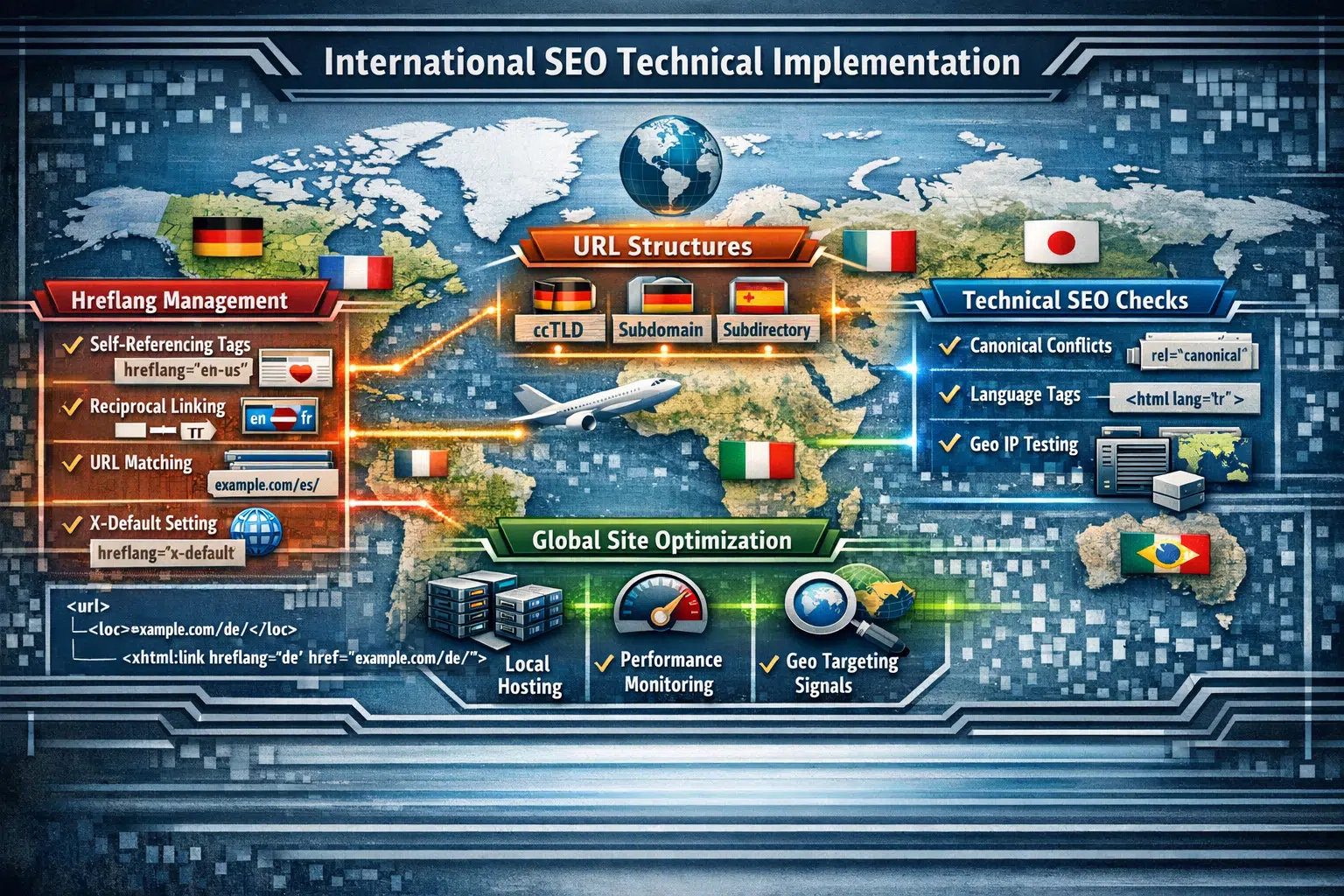
Hreflang: The Most Frequently Misconfigured Technical Element in SEO
Hreflang informs Google which version of a webpage should be served to a user based on their language and regional context. On paper, it seems easy enough. But in reality, it is responsible for creating more consistent SEO issues than nearly any other single component because it necessitates exact mutual referencing: all variations must reference one another, including themselves.
The four most common hreflang mistakes — and how to correct them:
Hreflang self-references missing. Every page must have a hreflang annotation pointing to itself. A page at /en-us/about/ must include its own annotation alongside annotations for all other language variants. If you leave out the self-reference, Google will distrust the entire hreflang cluster for that page.
Nonreciprocal annotations. If the English page at /en/ links to the French page at /fr/, then the French page at /fr/ must also link back to the English page at /en/. Any hreflang relationship not declared in both directions is treated as if it does not exist. For large international sites with hundreds of pages, maintaining reciprocal hreflang annotations manually is not practical — this is a strong use case for implementing hreflang via XML sitemap rather than HTML tags.
URL mismatches. Hreflang URLs must match the canonical URLs for those pages exactly — including trailing slashes, protocol (http vs https), and subdomain. If there is even a single character difference between the hreflang href and the actual page URL, the annotation is broken. To audit hreflang implementations, crawl the page HTML and the XML sitemap and compare the hreflang URLs to the canonical URL for each page.
x-default implementation. The x-default hreflang annotation specifies which page to show when no other language variant matches the user's context. It is most commonly used to point to a language selection page or the default version of the site. There are no active penalties for a missing x-default annotation, but it is a missed opportunity to ensure Google serves the correct page to users in unspecified language contexts.
Hreflang requires exact mutual referencing across every language variant on every page. A single broken link in the cluster can cause Google to distrust the entire implementation — making a systematic audit process non-negotiable before launch.
URL Structure Decisions and Their Long-Term Technical Consequences
When it comes to international sites, the ccTLD vs subdomain vs subdirectory URL structure is one of the most impactful early decisions in an international SEO project — because it is genuinely hard to change later, carrying significant migration risk.
ccTLDs (example.fr, example.de) provide the strongest geographic targeting signal and the greatest independence between country sites — each ccTLD can have its own domain authority and link profile. They are also the most expensive to maintain, requiring different domains and potentially different hosting, and the hardest to establish authority on from scratch.
Subdomains (fr.example.com, de.example.com) are treated by Google as sufficiently distinct to be counted as individual sites for some purposes, yet they still inherit domain authority from the root domain. They support geo-targeting through hreflang tags and Google Search Console's international targeting feature.
Subdirectories (example.com/fr/, example.com/de/) consolidate all link equity into a single domain. This option is the easiest to manage technically because it uses only hreflang for language targeting and relies on the international targeting tool in Google Search Console for geo-targeting, since there is no such signal built into the URL structure itself.
Agency recommendation: For most white-label clients, subdirectories are the right starting point — lower overhead, consolidated authority, and a reversible structure if the client later wants to migrate to ccTLDs. Present the alternatives with a clear rationale rather than defaulting to one without discussion.
Technical Auditing for International Sites
There are certain audit checks that apply specifically to international websites and are irrelevant to single-language sites. Hreflang consistency — covered above — is the most critical, but a complete international audit must also include:
Canonical vs. hreflang conflict detection. No page should use a canonical link pointing to a different-language page while also carrying hreflang tags. A canonical says "this other page is the preferred version," while hreflang attempts to declare both pages as valid for different audiences. The two signals directly contradict each other.
HTML lang attribute alignment. Every page should clearly declare the language it is written in via the correct lang attribute in the <html> tag. If this attribute does not match the hreflang setup, it can confuse Google and cause the wrong language version to appear in search results for a given country.
Geographic content delivery consistency. Some websites serve different content depending on the visitor's detected location. That becomes a problem if Googlebot — which typically crawls from US IP addresses — sees something different from what users in other countries see. If geo-based content delivery is in use, the site must be tested from multiple regional IP contexts to confirm that all versions are consistent and crawlable.
Additional Resources
Pam Harper
Founder of Harper Media Group. 20+ years of web development, 12+ years of technical SEO. Specializing in technical SEO, structured data, and AI optimization — delivered white-label for agencies.
About Pam Harper