Stand Alone Service Type:
Help Your Clients Rank For What Matters By Fixing How Their Site Is Built
White-labeled site architecture analysis, click depth optimisation, internal linking strategy, and hub page planning — per client site, under your agency brand.
Content quality and backlinks get most of the attention in SEO — but site architecture is often what determines whether any of that effort translates into rankings. Orphaned pages that search engines can’t reach. Priority pages buried four or five clicks from the homepage. Internal links that send equity to the wrong places. Hub pages that don’t exist. These are structural problems that content changes alone can’t solve. We map your client’s entire site architecture, identify where equity is being lost and authority is failing to build, and deliver a strategic internal linking plan that gives their most important pages the visibility they deserve — all white-labeled under your agency brand.
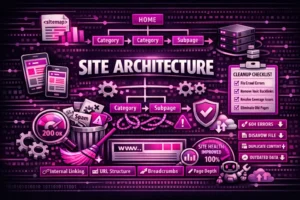
A well-planned site architecture starts with a hierarchical structure, typically featuring a homepage, main categories, subcategories, and individual pages. This hierarchy not only improves crawl efficiency but also strengthens internal linking, which distributes link equity throughout your site. Poorly structured sites, in contrast, can create orphan pages, deep click paths, and confusing navigation that frustrates users and hampers SEO performance.
Optimizing your site architecture involves evaluating URL structure, navigation menus, internal linking strategies, and mobile usability. Incorporating breadcrumbs, a sitemap, and clear categorization enhances both accessibility and search engine understanding. Additionally, keeping a shallow site depth ensures that important pages are reachable within a few clicks, maximizing visibility and engagement.
Regular audits of your site architecture help identify structural issues, such as broken links, duplicate content, or inefficient redirect chains. Maintaining a clean, logical architecture ensures that your site remains scalable, user-friendly, and optimized for search engines. Investing in strong site architecture not only improves SEO rankings but also enhances user satisfaction, ultimately driving higher conversions and long-term success.
For practical guidance on best practices, consider referencing the Moz guide to site architecture
What This Service Includes
Your site’s architecture determines how easily search engines and users can find your most important content. Poor structure buries valuable pages. Strategic internal linking builds topical authority and guides search engines to priority content.
This service analyzes your current architecture and builds a strategic linking plan to maximize PageRank flow and topical relevance.
Order this for clients who:
– Have good content that isn’t ranking — often a structural problem, not a content problem
– Have grown organically over time and never had their architecture reviewed — orphaned pages and broken equity flows accumulate fast
– Run content-heavy sites where topical authority needs to be built deliberately through pillar and cluster structures
– Have e-commerce stores with complex category hierarchies where product pages are too deep to crawl efficiently
– Are about to launch new content and want to ensure the site structure supports it before they invest in production
What We Deliver For Your Client
Information Architecture Analysis
– Full crawl-based map of the client’s current site structure and page hierarchy
– Click depth analysis identifying priority pages buried too deep to receive adequate crawl attention
– Orphaned page identification — valuable content with no internal links pointing to it
– URL structure and taxonomy assessment — documented in a visual architecture map your agency can present to the client
Click Depth Optimization
– Ensure important pages are 3 clicks or fewer from homepage
– Create hub and spoke content structures
– Implement breadcrumb optimization
– Navigation and footer link strategy
Internal Linking Strategy
– 10–20 strategic anchor text and internal linking recommendations per priority page on the client’s site recommendations for priority pages
– Identification of high-authority pages that should be passing equity to priority content
– Full topical cluster linking plan — pillar pages connected to supporting content in a structure Google can read as authoritative
– Contextual internal link recommendations with specific placement guidance — documented for the client’s content or development team to implement
Orphan Page Resolution
– Identify valuable pages with few or no internal links
– Create strategic linking plan to integrate orphaned content
– Recommend content consolidation where appropriate
Hub Page Strategy
– Identification of which topics warrant a dedicated hub page on the client’s site — and which already have one that needs strengthening
– Linking structure mapped from hub pages to supporting content and back
– Topical authority plan showing which content gaps need filling for the client to be seen as a credible authority in their topic area — delivered as a white-labeled strategic document
Deliverables
What your agency receives — ready to present to your client:
– White-labeled site architecture visual map showing the client’s full page hierarchy and equity flow
– Click depth analysis report identifying structural problems and their impact on crawlability
– 10–20 strategic internal linking recommendations per priority page with specific anchor text and placement guidance
– Hub page structure plan — which topics need pillar pages and how supporting content should connect to them / Implementation checklist your client’s content or development team can work from directly
FAQs
Common Questions
The clearest signals are good content with unexpectedly poor rankings, priority pages that rarely appear in Search Console performance data despite being actively maintained, high numbers of orphaned pages in a crawl audit, and important pages sitting more than three or four clicks from the homepage. If a client has invested in content quality and link building but rankings haven't moved, architecture is often the missing piece. We identify this definitively during the audit — mapping actual crawl behavior against the client's intended page hierarchy.
Internal linking is one component of site architecture, but the two aren't the same thing. Site architecture covers the full structural picture — URL taxonomy, content hierarchy, click depth, category organization, and how topical authority is built across related pages. Internal linking is the execution layer that connects those structural decisions. Improving internal links without addressing the underlying architecture is like fixing roads without fixing the city plan. We address both in a single project — the architecture analysis informs the internal linking strategy, so every link recommendation has a structural rationale behind it.
With a full crawl to understand what's actually there, followed by a click depth analysis to see what Google can realistically reach and prioritize. For large sites we focus on the highest-value areas first — the pages with the most traffic potential that are currently structurally disadvantaged. We don't try to fix everything at once. We deliver a prioritized plan that your client's team can work through systematically, with the highest-impact structural changes at the top.
Both. The strategy document maps the architecture and identifies what needs to change. The internal linking recommendations are specific — they identify which existing pages should link to which target pages, with suggested anchor text for each. Your client's content team or developer can implement these directly from the checklist we provide. We don't hand over a vague strategy and leave the implementation thinking to your client — every recommendation is actionable.
Not necessarily redone from scratch, but revisited. As a site grows, new content creates new orphan pages, existing hub pages may need to be updated with links to new supporting content, and click depth for priority pages can increase as the site expands. We include ongoing architecture maintenance recommendations in every project handover — typically a light structural review every six to twelve months for active publishing clients, and after any major site restructure or content expansion.
Site Architecture Pricing
High-value deliverable. Agencies commonly resell Standard at $1,800–$2,200 client-facing.
Basic
8-10 hrs
$650
- Top-level URL structure audit
- Content hierarchy review
- Internal linking gap analysis
- Architecture recommendations report
Standard
15-19 hrs
$1300
- Everything in Basic
- Full site architecture redesign plan
- Topical cluster mapping
- Internal link buildout strategy
- Wireframe-level content map
Premium
25-32 hrs
$2300
- Everything in Standard
- Competitive architecture analysis
- Migration architecture planning
- Developer handoff documentation
- Post-launch validation review
Ready to Add Technical SEO and AI Optimization to Your Service Menu?
Book a free 30-minute partner strategy call. We’ll walk through your client roster, identify which services fit, show you the AI Analytics Platform live, and confirm pricing. No obligation.
