Entity-Based SEO: The Foundation of AI Citation Strategy
However, the transition from keyword-oriented to entity-oriented search is not something that recently happened because Google’s Knowledge Graph has been based on entity connections since 2012. The novelty lies in the extent to which the entity will decide whether the website can be referenced when providing answers using artificial intelligence.
What an Entity Is and Why It Matters for AI
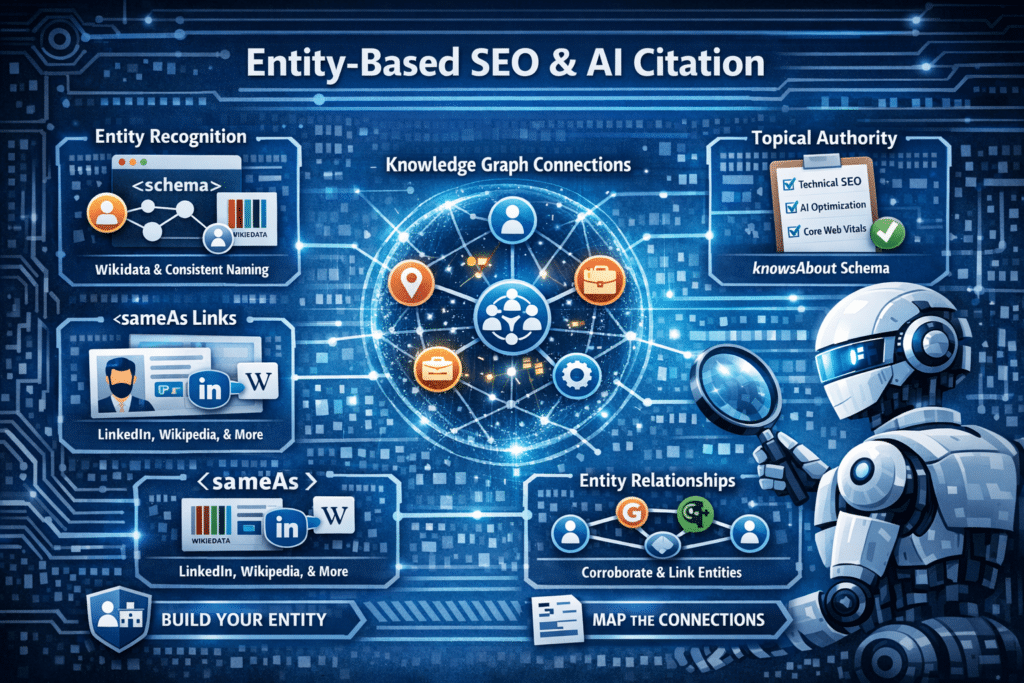
From the point of view of search engines, an entity refers to any named, concrete thing from our reality, which can be distinguished through identity and not by means of keywords: it could be a person, company, product, location, idea, creative piece of work, and so forth. Entities are distinct from keywords due to the difference in the way their meaning is understood. “Technical SEO” as a keyword is just an arbitrary combination of letters. “Technical SEO” as an entity is the name for a specific thing, which has relationships with other entities: Screaming Frog, Search Console, Google, Ahrefs, Gary Illyes, John Mueller, etc.
The AI of modern search engines utilizes graphs of entities when deciding on whom to give citation for a particular subject. If the website of your client is not identified as an entity within Google’s Knowledge Graph or if the entities connected with the website do not have enough connections with the subject matter, the citation chances are greatly reduced, irrespective of content quality.
Building Entity Recognizability for Client Sites
Entity recognisability is achieved through consistency and corroboration. A website that uses consistent naming for its founder across the site, references him/her in his/her LinkedIn profile, declares these relationships using schema, and is referenced externally with consistent naming patterns – that website is establishing entity recognisability. The external reference serves as corroboration of the internal assertion.
The simple checklist for establishing entities is:
Consistency in entity naming. The company name, founder name, and major service names should remain consistent in the use across the website, in structured data, in Google My Business, on social media platforms, and in any media coverage. Even small deviations such as using acronyms, different spellings, or word order make an entity less recognizable.
Presence on Wikidata. Wikidata is the structure layer powering Wikipedia and used extensively in Google’s Knowledge Graph. Adding and filling out a Wikidata record for your business or its key players with external sources improves entity recognition. This is one of the most impactful things to do in order to improve citation by AI algorithms for notable businesses or persons in a particular niche.
SameAs Schema Properties. The sameAs JSON-LD property means that “this item from our website is the same as this item on an external authoritative website.” Connecting the schema for Organization and Person to their LinkedIn pages, Crunchbase entries, Google My Business, and Wikidata pages forms a corroboration circle that AI systems leverage to confirm their identities.
Topic Authority Declaration. The property knowsAbout on Organization and Person schemas enables declaration of topical authorities explicitly. The knowsAbout property isn’t used extensively yet, providing an inherent edge to early adopters. Some of the values of the knowsAbout property for a white label SEO agency would be as follows: Technical SEO, Structured Data Markup, AI Search Optimization, Crawl Budget Optimization, Core Web Vitals.
Entity Relationships and the Citation Graph
However, AI is not limited to recognizing individual entities. Instead, it models their connections with each other. A website will have a higher chance of being referenced by an AI system if it resides at the meeting point of several entity relationships pertinent to a particular search. For instance, a piece on how to optimize crawl budget is more likely to be cited by an AI tool if:
• The author entity relates to “technical SEO” as their area of expertise
• The organization entity relates to “white label SEO services” as one of their core offerings
• The article cites several other entities in the same domain as “technical SEO” (other tools, platforms, research organizations)
• The article is in turn cited by other webpages on the website that are also related to the technical SEO entity set
Creating this kind of entity relationship network cannot be accomplished in a single implementation effort; it requires a sustained content strategy approach that actively grows the entity relationships network by creating content that links entities, referencing credible external sources, and earning entity mentions from sources where entity graphs intersect with the target topic cluster.
If you’re running this process for your clients as an agency, then the actionable outcome of the entity-based SEO audit will be a knowledge graph map that indicates the current entities that are being linked through the client website, the missing entities in the target topic cluster, and how best to bridge that gap.
Additional Resources: AI SEO Optimization, Introduction to structured data markup in Google Search