
Optimizing for AI Search Engines: A Practical Agency Framework
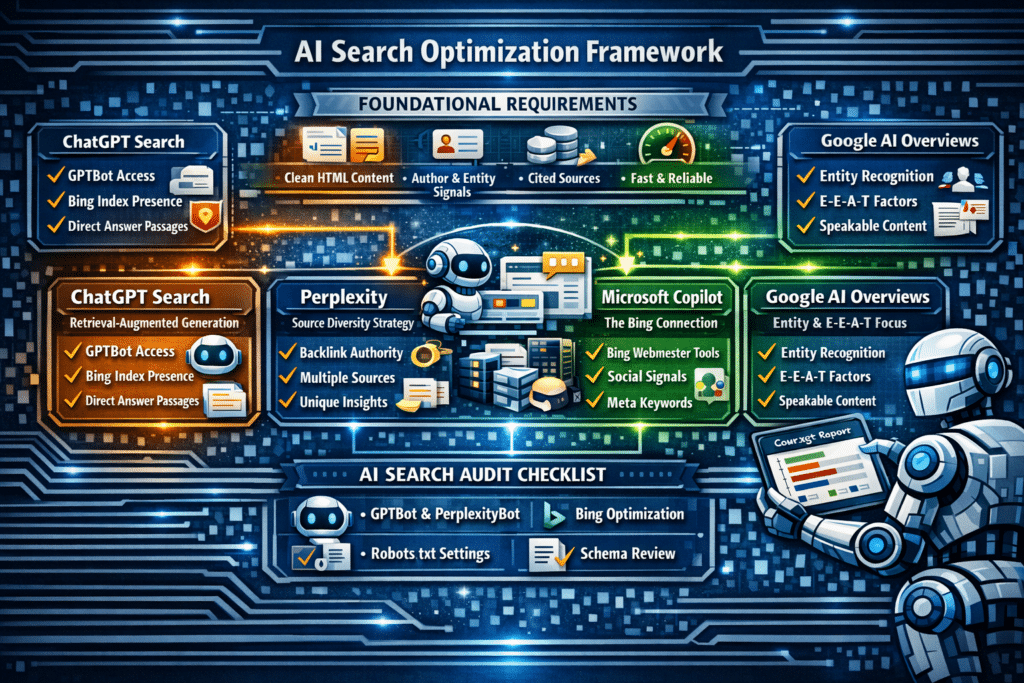
The world of searches in 2025 is not limited to any single avenue. If a customer poses a question, the answer could come from AI Overviews powered by Google’s AI algorithms, ChatGPT Search, Perplexity, or Microsoft Copilot, or even a mixture of all four of these. They all have unique technical designs, separate source selection practices, and separate criteria that make your clients’ content eligible for citation.
Those agencies that consider AI searches as one and the same field will develop strategies that partially succeed, but not entirely. What you need to keep in mind here is that each of these AI searches has specific technical needs, along with common ones that suit all of them equally well.
The Foundational Layer: What All AI Search Systems Need
Before delving into the particulars for each of these platforms, there is a baseline set of technical features which any AI search system — whether it is Google, OpenAI, Perplexity, or Anthropic — will need in order to make any claim about citing the page.
Parseable content structure. An AI search engine parses HTML pages to find passages worth quoting. Content hidden behind JavaScript, contained within iframes, or displayed as an image cannot be parsed by most AI bots. The main content on any page, especially the parts that can be considered citations-worthy information, needs to be present in HTML, appropriately tagged with heading sections all the way down to H1, H2, and H3.
Clarity of Author and Organisation. Every AI system uses some kind of credibility assessment of sources. This means that in case of written sources, it is important for the author to be known and verifiable as well as having certain credentials from other independent sources. For organisations, the same principle is valid. It should be possible to verify their identity based on Google Business Profile, LinkedIn page, and other structured sources.
Factuality and Source Citation. AI systems retrieving information to include in an answer tend to prefer pages making verifiable claims based on named or cited sources and data. Such pages are favoured against pages making vague or not verifiable statements or pages that contain no credible source citations or attribution at all.
Page speed and availability. AI search engines will cache and recrawl pages on differing schedules. Pages that were slow or not available at the time of a crawl may be dropped from consideration until the next crawl. The relationship between Core Web Vitals performance and citations holds true even beyond Google Search use cases.
ChatGPT Search: Retrieval-Augmented Generation and What It Means Technically
The ChatGPT search engine utilizes the retrieval-augmented generation (RAG) method. After receiving the query from the user, the search engine selects several candidate pages using its index created by OpenAI, retrieves information from those pages, and feeds the relevant information as input to the language model to produce an output answer. The citation provided in the answer refers to the source from which information has been extracted.
For a web page to be cited in the ChatGPT search engine, the page must be:
Crawlable with GPTBot. The name of OpenAI’s crawler is GPTBot, which can be allowed/disallowed through robots.txt commands. GPTBot is frequently denied access by catch-all disallow statements in robots.txt files on various websites. Checking that GPTBot is allowed to crawl using the robots.txt file is the first technical verification needed before ChatGPT citations.
Indexed in OpenAI’s Index. OpenAI possesses its own web index apart from the one of Google. A substantial portion of this index comes from Bing — Bing Webmaster Tools being used by OpenAI due to Microsoft’s investment in it means that content indexed with Bing has an architectural edge when it comes to ChatGPT citations.
Answer passages that can be directly extracted. When using ChatGPT to retrieve content, a preference is given to pages that feature an answer to a common question that is provided in a concise and self-contained passage, preferably within the first 20% of the page, under a distinct heading, and without any need for context elsewhere on the page to interpret it. This parallels the structure required by Google’s Featured Snippets, which explains the many similarities in terms of how both systems operate technically.
Perplexity: Diverse Sources and Domain Authority Indicators
What sets Perplexity apart from ChatGPT is that Perplexity tries to cite several different sources for the same answer. This means that pages do not necessarily have to be considered the most authoritative when it comes to a particular topic in order to be included as citations; all that is required is that the page provides a unique contribution to an existing set of sources.
When considering citation opportunities for clients working in the agency world, this presents a useful strategy: identifying the individual sub-claims or pieces of information that the client’s page is uniquely able to provide within a broader topic.
Perplexity employs the use of PerplexityBot as its crawler, and as such, permission should be granted in robots.txt as well. It seems that Perplexity relies on domain authority indicators based on external links more heavily than some other AI platforms – which means that traditional link-building becomes an important factor in how one achieves visibility through Perplexity citation coverage, as opposed to the entity-based indicators that matter for Google AI Overviews.
Microsoft Copilot: The Bing SEO Link
The Microsoft Copilot’s content retrieval is from Bing’s index, meaning Bing SEO is now more important than ever before in Copilot citations. Agencies who have historically viewed Bing optimization as secondary can no longer afford to maintain that mindset.
In addition to Bing Webmaster Tools offering its own unique diagnostic tools separate from those offered by Google Search Console, there is the basic requirement to submit sitemaps to Bing Webmaster Tools, resolve Bingbot crawl errors, and ensure verification within Bing. Bing is also known to give more importance to specific technical factors that may have differing importance levels with Google, such as meta keywords, on-page keywords, and LinkedIn social signals.
For B2B agencies that cater to clients in the professional services verticals, a citation in Microsoft Copilot is especially relevant because it is deeply integrated with Microsoft 365. This means that Copilot citations will surface right in the work environment of decision-makers using Outlook, Teams, and Word. It’s a completely new way to get a citation in front of the audience, and one that stands out from a traditional search engine results page appearance.
Building an AI Search Audit Into Standard Technical SEO Delivery
The practical impact on agency teams is that AI search optimization readiness needs to become a mandatory part of each technical SEO audit. The new checklist additions are limited: permissions of GPTBot and PerplexityBot in robots.txt; verification and sitemap submission via Bing Webmaster Tools; llms.txt file setup and management; deployment of the Speakable and author schema; as well as checking content structure for passage extraction.
Including these checks into an existing technical SEO audit checklist would only take several hours to do. Yet the advantage for the client side is substantial because, as AI search engines keep absorbing ever more of the informational query volume, clients who are ready technologically will preserve their organic presence and gain from it while others will slowly lose it.
Additional Resources: How to Appear in Chatgpt Search Results, How to Get Cited in Google AI Overviews, AI Optimization, Structured Data, Overview of OpenAI Crawlers
