
How to Get Cited in Google AI Overviews

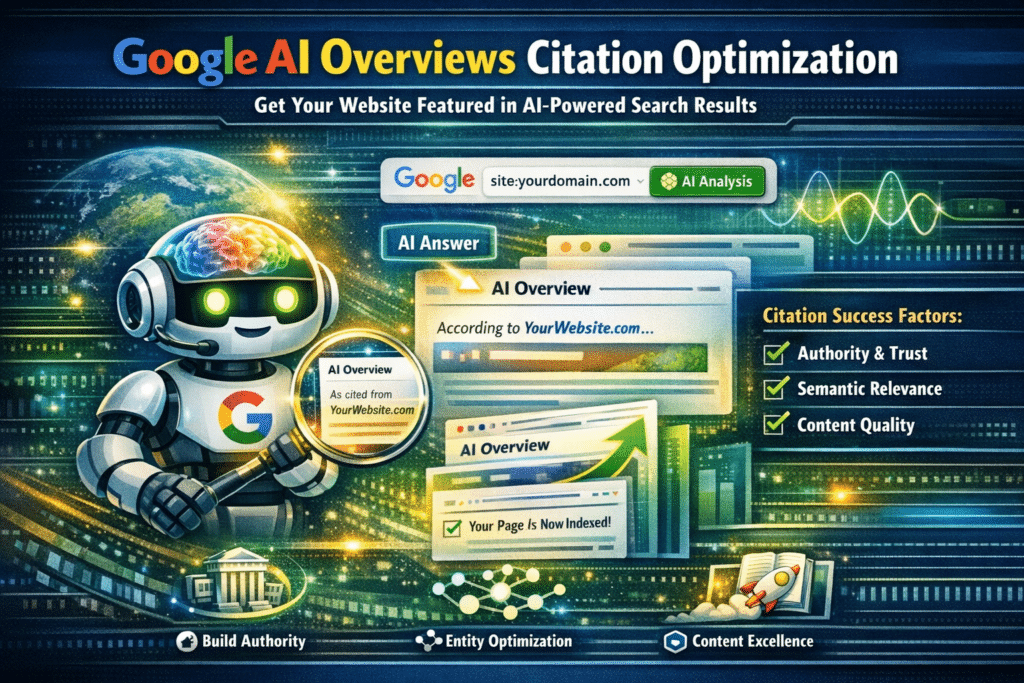
Google AI Overviews now appear at the top of nearly half of all Google searches, above every organic result, every featured snippet, and every paid ad. The websites cited inside those AI Overviews are capturing clicks, brand exposure, and authority signals that their competitors simply cannot access through traditional SEO.
If your website isn’t being cited, you’re not just missing traffic. You’re watching a competitor get credited as the authoritative source on topics you should own. This guide breaks down exactly how Google AI Overviews work, why most sites are excluded, and the specific optimizations that significantly increase your chances of being cited.
What Are Google AI Overviews?
Google AI Overviews (formerly Search Generative Experience or SGE) are AI-generated summaries that
appear at the top of Google search results. Rather than displaying a list of links, Google synthesizes information from multiple sources and presents a direct answer, with attribution links to the sources it drew from.
Those attribution links are the citation opportunity. When Google AI Overviews cite your content, users see your brand as a trusted source before they see a single organic result. According to Google’s own Search documentation, AI Overviews are designed to help users “get the information they need quickly”, which means Google is looking for sources that are comprehensive, trustworthy, and technically well-structured.
Why Most Websites Aren’t Cited in Google AI Overviews
Thin or Incomplete Content
Google AI Overviews synthesize answers from sources that fully address a topic. If your content touches the surface of a subject without providing depth, context, or nuance, Google will pull from a competitor who does.
Missing or Incorrect Structured Data
Schema markup is how you formally communicate to Google what your content is, who created it, and why it’s credible. Without it, Google has to infer, and inference is unreliable. Websites with well-implemented Organization, Article, Author, and FAQ schema are significantly more likely to be included in AI Overviews.
Weak E-E-A-T Signals
Google’s evaluation framework — Experience, Expertise, Authoritativeness, and Trustworthiness, has never been more important. AI Overviews are built to surface the most credible sources. If your site doesn’t
demonstrate clear expertise, verified authorship, and consistent trust signals, you’ll consistently be
deprioritized.
Poor Technical Health
Slow load times, crawl errors, broken internal links, and indexation issues all prevent Google from reading your content cleanly. If Googlebot struggles to access your pages, the AI systems processing that content struggle
too.
How to Optimize for Google AI Overviews Citations
- Answer Questions Directly and Completely
Google AI Overviews are triggered primarily by question-based and informational queries. To be cited, your content needs to state the direct answer early, within the first paragraph, provide context and nuance, address related questions using headers, and use natural conversational language that AI systems recognize as authoritative. - Implement FAQPage Schema
FAQPage schema is one of the highest-impact structured data types for AI Overview visibility. When you mark up your frequently asked questions in JSON-LD format, you’re providing Google with pre-formatted question-and-answer pairs that are precisely the kind of content AI Overviews are built to synthesize and cite.
Every page on your site that answers common questions, service pages, blog posts, landing pages, should have FAQPage schema implemented with the actual questions your target audience is asking. - Build Comprehensive Author and Organization Schema
Google evaluates source credibility heavily when selecting AI Overview citations. Implement Person schema for every content author with credentials and verified profiles, Organization schema with complete business information, and WebPage schema that connects each piece of content to its author and the publishing organization. This creates a verifiable trust chain that Google’s AI systems can evaluate and confirm. - Develop Content Depth With Semantic Clusters
A single well-written article is less likely to be cited than a site that demonstrates comprehensive topical authority. Build content clusters around your core subjects: a central pillar page covering the full topic landscape, supporting pages addressing specific subtopics in depth, and clear internal linking between related pages so Google understands the topical relationships. - Optimize for Featured Snippets First
There is a strong correlation between content that earns featured snippets and content that gets cited in AI Overviews. To win featured snippets: use clear concise definitions at the start of content sections, format lists and step-by-step processes with proper HTML structure, keep definition paragraphs to 40-60 words, and use headers that match common query phrasings. - Ensure Flawless Technical SEO
None of the content and schema work above matters if Google can’t consistently crawl and index your pages. Before investing in AI Overview optimization, audit and resolve: indexation issues, page speed (LCP under 2.5 seconds), mobile usability, and canonical tag conflicts.
Monitoring Your AI Overview Performance
Google Search Console is beginning to surface impression and click data for AI Overview citations. In the
meantime, monitor your performance by searching your target queries manually in Google and noting whether your content is cited, tracking which pages receive unexplained traffic increases, and monitoring your brand mentions across the web.
The Bottom Line on Google AI Overviews
Getting cited in Google AI Overviews is not luck, it’s the result of technical precision, content depth, structured data implementation, and credibility signals working together. The optimization required is more sophisticated than traditional SEO, but the visibility reward is positioned above everything else on the search results page.
For agencies looking to provide technical SEO optimization to their client sites and for businesses ready to stop seeding ground to competitors, Harper Media Group’s AI Optimization service delivers the full technical stack required to earn consistent citations. Visit harpermediagroup.com/ai-optimization/ to learn more.
Outbound Resource: Google’s official guidance on AI Overviews: Google’s Search documentation on how AI Overviews select and cite sources: https://developers.google.com/search/docs/appearance/ai-overviews
